Structural Drying and Dehumidification in Temple, TX
Pulling out the water is only half the job. The drying team dries framing, subfloors and wall cavities with dehumidifiers and air movers, and the daily readings prove it.
(888) 926-4485Dry the framing right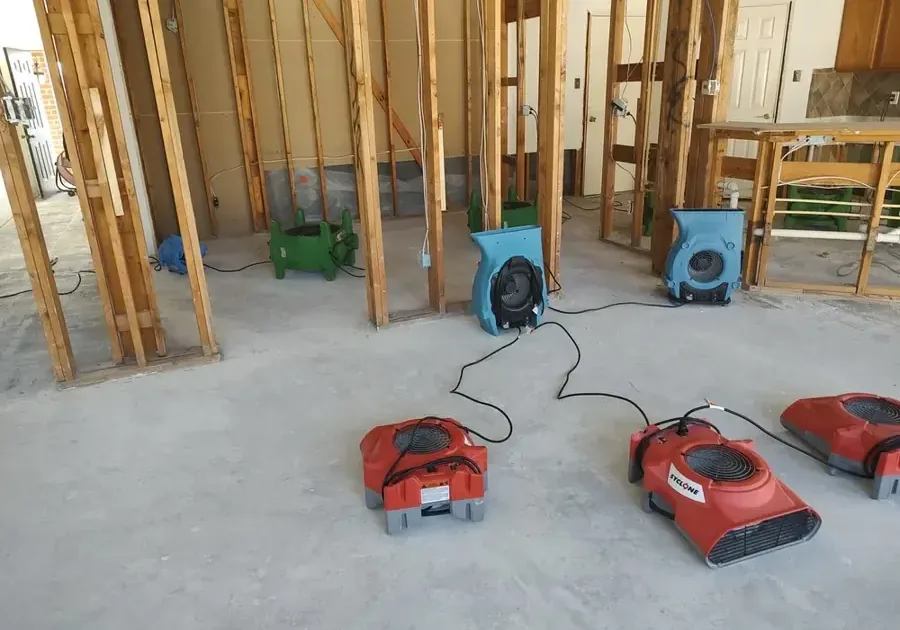
First steps for structural drying and dehumidification
- 1Get the water out firstExtraction comes before drying, because gear cannot dry a floor that is still wet on top.
- 2Leave the walls aloneDo not paint, seal or cover wet drywall or flooring while it is still damp.
- 3Keep doors and vents clearEquipment needs open space and steady power to run for several days.
- 4Ask for the logsDaily readings show the drying is progressing and support the insurance claim.
How structural drying and dehumidification is handled
- 1
Measure
Meters, a thermal camera and a psychrometer record starting moisture and humidity.
- 2
Set the equipment
Equipment is placed to match the room, the materials and the damage class.
- 3
Monitor daily
Readings are taken at each visit and the equipment is moved or adjusted to match them.
- 4
Verify dry
Gear comes out only when every material reaches its dry standard.
What does structural drying and dehumidification cost in Temple, TX?
One room with a Class 1 or 2 loss runs $1,000 to $2,000. Several rooms run $2,000 to $6,000, and Class 4 materials such as hardwood or slab run $6,000 to $12,000.
One room, Class 1 or 2
- Air movers and a dehumidifier
- Daily moisture readings
- Drying logs kept
Several rooms
- Several LGR dehumidifiers
- Wall cavity drying in place
- Psychrometric logs kept
Class 4 materials
- Desiccant dehumidifiers
- Hardwood or slab drying
- Extended monitoring period
These are typical ranges, not a quote. Water category, square footage, material class and how fast drying started move the number most. For a closer planning figure, run the water damage cost calculator.
Water that is pumped away still leaves moisture in wood, drywall and concrete. Structural drying removes it on purpose, with controlled air and humidity, so materials return to normal instead of staying damp inside the wall.
How structural drying works
Air movers push dry air across wet surfaces while dehumidifiers pull the moisture out of the room. Technicians measure temperature, humidity and material moisture at each visit, then adjust the equipment to fit the readings.
- Air movers set to cross wet walls and floors
- LGR dehumidifiers for most rooms, desiccant units for dense materials
- Cavity drying through small holes or opened baseboards
- Equipment removed only when readings reach the dry standard
Structural drying after storms in Temple
After storm and flood events such as the November 7, 2024 downtown flooding, drying framing and subfloors follows water removal. Heavy rain leaves wall cavities and subfloors that can look dry on top and still hold water.
What structural drying readings show
Wet materials are classed by how much water they hold and how fast it leaves, from thin Class 1 or 2 losses up to Class 4 for dense materials such as hardwood and slab. Higher classes need desiccant units and longer monitoring. Water extraction comes before drying, and concrete drying after a slab leak is the extreme case.
Dry means measured. A floor that feels dry can still read wet inside, so equipment stays until the meter, not the touch, says it is finished.
Structural drying and dehumidification across Temple and nearby towns
Drying crews work across Temple, including Lake Pointe, Hills of Westwood, Canyon Creek, Bella Terra and South Pointe, and in businesses along South 31st Street.
The same service nearby: structural drying and dehumidification in Belton, Harker Heights, Killeen.
Structural Drying and Dehumidification questions
How long does structural drying take?
It depends on the materials, the water category and the humidity. Equipment stays until readings reach the dry standard, so the schedule follows the data.
Why does drying equipment run so long?
Wood, drywall and concrete release moisture slowly. Dehumidifiers pull it from the air as fast as materials give it up, and shutting off early traps what remains.
What is an LGR dehumidifier?
A low grain refrigerant unit that removes moisture even when the air is already fairly dry, which makes it the workhorse for most water damage jobs.
When are desiccant units used?
For dense materials such as hardwood and concrete, and where refrigerant units struggle. They pull moisture chemically and work with air movers.
Can wet walls be dried without removing drywall?
Often yes. Small holes or removed baseboards let air reach the cavity, and drywall comes out only if it is saturated or contaminated.
How does the insurer know drying worked?
Dated moisture and humidity logs from each visit show the starting point, the progress and the final dry readings.
Materials still reading wet?
The drying team sets the equipment, measures every material daily and keeps the gear running until each reading reaches the dry standard.
(888) 926-4485Bring in the dehumidifiersBelton Water Damage Restoration
Temple, TX · Bell County
Open 24 hours, 7 days a week