Structural Drying and Dehumidification in Harker Heights, TX
Once the standing water is gone, moisture stays locked in drywall, framing and subfloor. The drying team uses dehumidifiers, air movers and daily readings to bring every material back to dry.
(888) 926-4485Start a dry down plan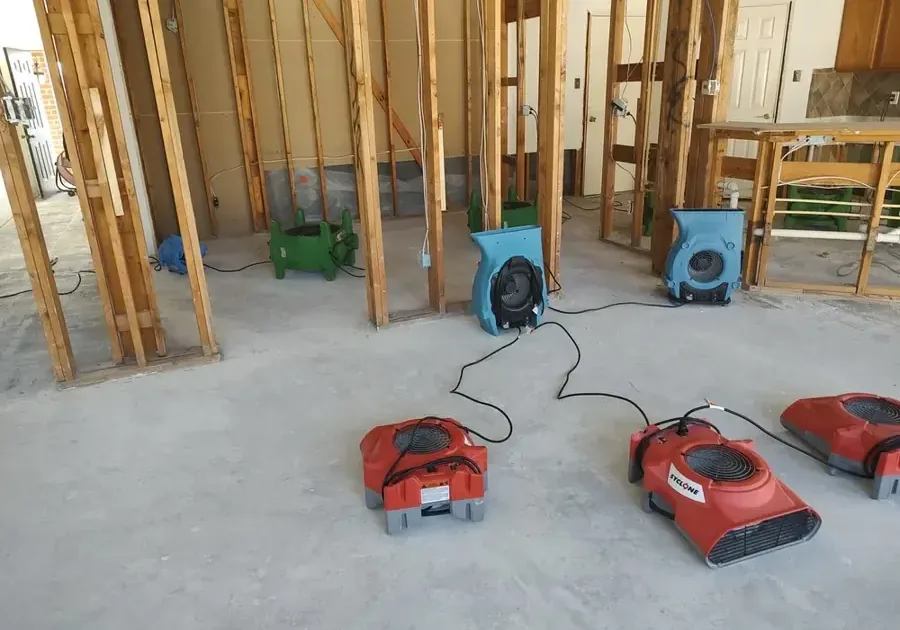
First steps for structural drying and dehumidification
- 1Close the building upWindows and doors stay shut so dehumidifiers work on the wet room, not on outdoor air.
- 2Leave equipment runningAir movers and dehumidifiers work around the clock, and stopping them early leaves damp materials behind.
- 3Keep furniture out of the roomOpen floor and wall space lets air reach every wet surface.
- 4Expect daily checksReadings show which materials are drying and which need equipment moved.
How structural drying and dehumidification is handled
- 1
Measure the starting point
Meters and thermal images record wet materials and set the dry goals.
- 2
Place the equipment
Air movers and dehumidifiers are sized to the room and set for airflow across wet surfaces.
- 3
Monitor and adjust
Daily readings steer moving, adding or removing equipment.
- 4
Confirm dry goals
Final readings and logs show each material has reached its target.
What does structural drying and dehumidification cost in Harker Heights, TX?
A single room with Class 1 or 2 materials usually costs $1,000 to $2,000 to dry, several rooms cost more, and Class 4 materials such as hardwood or slab sit at the top of the range.
One room, Class 1 or 2
- Air movers and a dehumidifier
- Daily readings
- Drying logs
Several rooms
- LGR dehumidifiers
- Cavity drying
- Psychrometric logs
Class 4 materials
- Desiccant units
- Hardwood or slab drying
- Longer monitoring
These are typical ranges, not a quote. Water category, square footage, material class and how fast drying started move the number most. For a closer planning figure, run the water damage cost calculator.
Drying is a controlled process, not an open window and a fan. In Harker Heights the outdoor air is often warm and humid, so opening a house up usually adds moisture instead of removing it.
How structural drying works
Air movers raise evaporation at the surface, and dehumidifiers pull the released moisture out of the air so it cannot settle somewhere else. Both only work in a closed, controlled space, and skipping that rule is the usual reason a repaired room smells damp again a week later.
- Temperature and humidity are logged each visit
- Wall cavities are dried through small openings
- Equipment is moved as readings change
- Drying ends only at the dry goal for each material
Drying classes and equipment choices
Class 1 and 2 losses involve limited wet materials and standard LGR dehumidifiers. Class 3 involves water from above, and Class 4 involves dense materials such as hardwood, plaster or slab, which can need desiccant dehumidifiers and longer monitoring.
The crew picks equipment from measured readings rather than a standard package, so a small room gets what it needs and a large loss gets more.
Structural drying after different water losses
Every loss from a burst pipe to a roof leak ends in the same drying phase. After flood or sewage losses, contaminated materials are removed first and structural drying follows. See also water extraction. Measured drying also lets repairs begin on a known date instead of a guess.
Why logs matter. Daily readings prove the structure reached its dry goals, which protects the claim and the finished repairs.
Structural drying and dehumidification across Harker Heights and nearby towns
Drying equipment goes to homes across the city, from Cedarbrook Ridge and Comanche Gap to Cardinal Lane, Pecan Meadows and the commercial areas around Market Heights.
The same service nearby: structural drying and dehumidification in Belton, Killeen, Temple.
Water damage restoration in Harker Heights · every town covered
Structural Drying and Dehumidification questions
How long does structural drying take?
Usually three to five days for ordinary losses, longer for dense materials. Daily readings decide when the job ends, not a fixed schedule.
Why not just open the windows?
Humid air outside carries moisture that slows evaporation, so a closed room with dehumidifiers dries materials faster and more reliably.
What is the difference between LGR and desiccant dehumidifiers?
LGR units work well for most losses, while desiccant units handle dense materials and low-humidity targets where standard units slow down.
What are drying classes?
Class 1 through 4 describe how much and how deep the water went, from limited wet materials to dense floors and walls.
Can equipment be turned off at night?
It should stay on. Drying slows or stalls when equipment stops, and moisture returns to materials that dried only at the surface.
What records come with drying?
Moisture maps, daily psychrometric readings, equipment logs and photos, all organized for the adjuster.
Moisture stays inside after the puddle is gone
Drywall and framing release moisture slowly, and unmonitored drying can leave damp cavities behind finished surfaces.
(888) 926-4485Set up the dry downBelton Water Damage Restoration
Harker Heights, TX · Bell County
Open 24 hours, 7 days a week